
Yes, once your VAT-taxable sales pass £90,000 in any rolling 12 months, or you expect one 30-day period alone to pass it, you must register. Selling on Amazon, eBay, Etsy or your own site makes no difference to that rule. Below we set out the two tests, what marketplaces do and don’t cover, and when registering early pays. Our All-inclusive plan covers VAT returns for online sellers.
Key takeaways
- The UK threshold is £90,000 of taxable turnover, measured on a rolling 12-month basis, not by tax year or calendar year.
- A second test catches sudden growth: if you expect to pass £90,000 in the next 30 days alone, you must register.
- A marketplace collecting VAT on some sales does not register you or remove your own duty to register.
- Below the threshold, registration is optional. It can help if your customers are VAT-registered businesses or you have large VAT-bearing costs.
- Registering late can bring penalties and a VAT bill for sales you never charged VAT on.
Table of Contents
- The two tests that decide whether you must register
- What counts as taxable turnover
- Does selling through Amazon, eBay or Etsy change anything?
- Platform reporting to HMRC: why HMRC may already know
- What happens if you register late
- Should you register voluntarily below £90,000?
- Selling to customers outside the UK
- How to register and what to do first
- Our perspective: registering is a bookkeeping job first
- Getting help with VAT registration and returns
- FAQ
- Sources
The two tests that decide whether you must register
HMRC applies two separate tests. Fail either one and you must register. The rules are set out on GOV.UK’s guidance on when to register for VAT.
Test 1: the rolling 12-month test. Add up your taxable turnover for the last 12 months. If it is over £90,000, you must register. This is checked every month, looking back at the previous 12 months, so you can cross the line part-way through a tax year. The Low Incomes Tax Reform Group’s worked example shows the timing: if the 12 months to 31 August 2026 come to more than £90,000, you must register by 30 September 2026, and you normally charge VAT from 1 October.
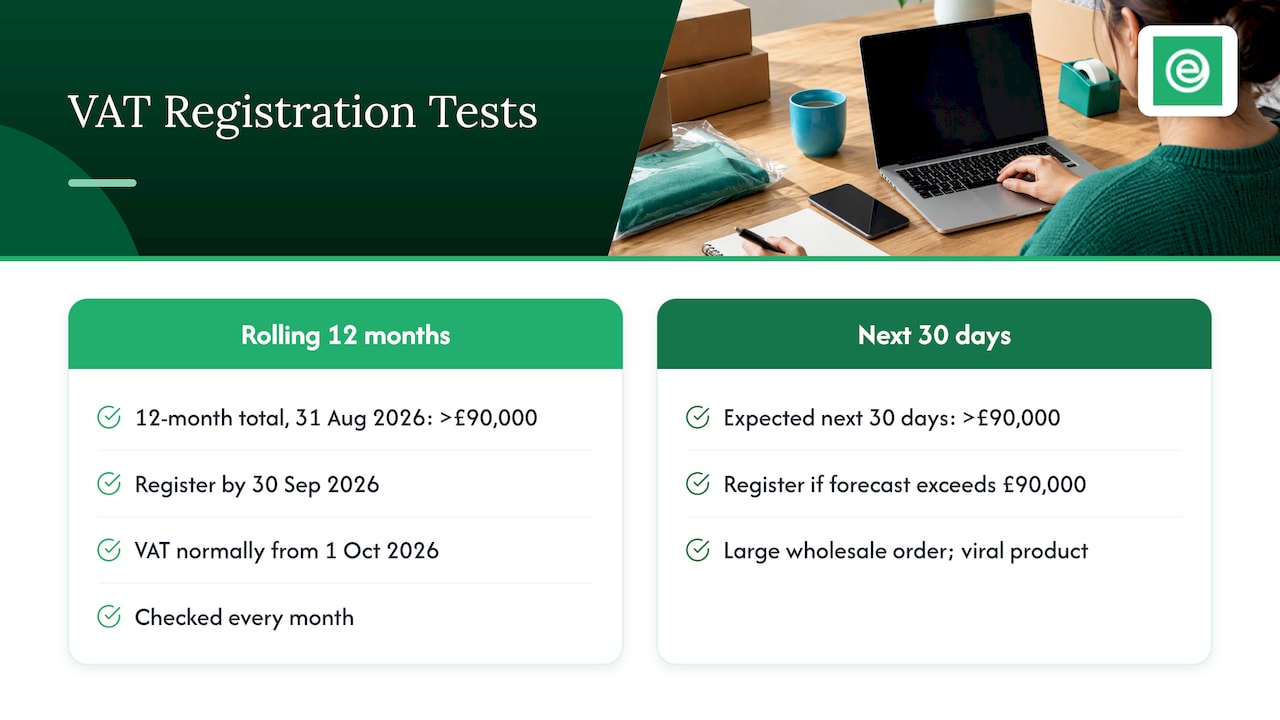
Test 2: the forward-looking 30-day test. If you expect your taxable turnover to go over £90,000 in the next 30 days, you must register. This is the one that catches sellers whose sales are lumpy, for example someone who lands a large wholesale order or has a viral product in the run-up to Christmas.
The £90,000 figure has applied since the threshold rose from £85,000 to £90,000 in April 2024. The same page covers the deregistration threshold, which is lower, so you can ask to cancel if your turnover drops below it.
We have a separate walk-through for sole traders on the £90,000 rolling threshold and 30-day registration rule.
What counts as taxable turnover
This is where online sellers most often miscount. Taxable turnover is the total value of everything you sell that is not exempt from VAT. That includes standard-rated and reduced-rate sales, and zero-rated sales too. Zero-rated goods still count towards the threshold even though you charge 0% on them.
It is a measure of sales, not profit. If you sell £95,000 of stock and make £12,000 after costs, you are over the threshold.
For a typical online seller, a practical checklist looks like this:
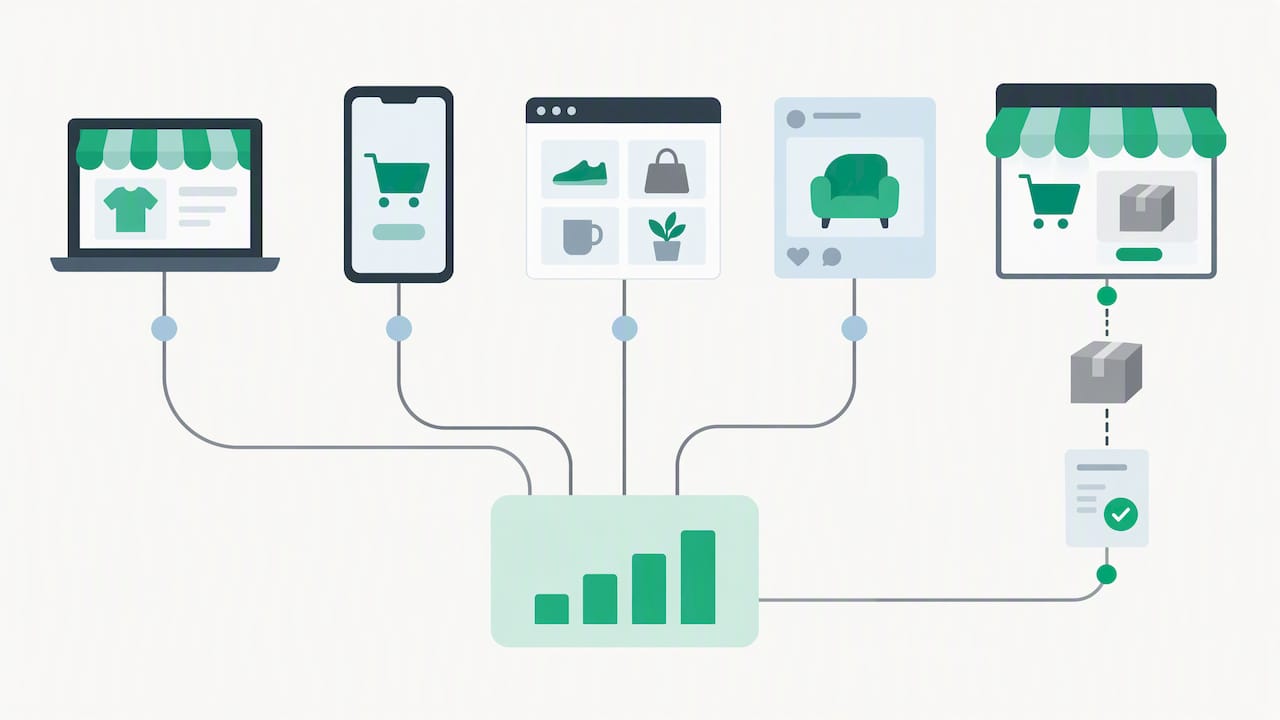
- Add up gross sales across every channel: your website, Amazon, eBay, Etsy, social selling and any in-person sales.
- Use the sale value, not what lands in your bank. Marketplace payouts are net of fees and refunds, so they understate turnover. Use the sales report, not the payout report.
- Include all businesses you run in your own name. If you are a sole trader with two shops, the turnover is combined.
- Roll the window forward every month. A calendar-year or tax-year total is not the test.
In Xero, a sales-by-month report with marketplace sales imported at gross value gives you the rolling figure in minutes. If your fees and refunds are still being posted as net lumps, fix that first, or you will misjudge where you stand.
Does selling through Amazon, eBay or Etsy change anything?
It changes who collects VAT on some sales. It does not change whether you must register on your total turnover. GOV.UK’s marketplace guidance explains that a marketplace can be treated as the “deemed supplier” and be responsible for the VAT on certain sales. That applies in particular to consignments of £135 or less sold to UK customers from overseas, and to goods held in the UK by an overseas seller. There are separate rules for Northern Ireland.
If you are a UK business selling UK-held stock to UK customers, the marketplace is not usually the one accounting for the VAT. You are, once you are registered.
The misconception we hear most is “Amazon handles VAT for me”. On the sales where a marketplace does account for VAT, it is accounting for that transaction only. HMRC’s guidance for small businesses on VAT returns makes clear that the registration duty sits with you as the business. Our article on marketplace VAT and the £135 rule shows how to treat the two kinds of sale in your books.
One practical point once you register: the name on your marketplace seller account should match the name on your VAT registration. HMRC warns that marketplaces can remove sellers whose VAT details they cannot verify.
Platform reporting to HMRC: why HMRC may already know
Since 1 January 2024, digital platforms have had to collect seller details and report them to HMRC. GOV.UK’s digital platform guidance says that sellers are generally exempt from reporting if they make fewer than 30 sales and receive less than around £1,700 (2,000 euros) in a year. The exemption does not cover services or property rentals.
In plain terms, if you sell regularly through platforms, assume HMRC can see your sales totals. A seller who is over £90,000 and unregistered is not hidden. The sensible move is to check your own figures monthly rather than wait for a letter.
What happens if you register late
The date you should have registered is what counts, not the date you noticed. HMRC expects you to act without being told. GOV.UK explains how to register, and late registration means you owe VAT on sales from the date registration should have started. In practice, that often means paying VAT out of your own pocket on sales where your customer paid you a VAT-free price.
There can be a penalty on top. HMRC’s compliance handbook says the penalty is based on the VAT unpaid, and that penalties can be reduced for a non-deliberate failure disclosed unprompted within 12 months, in some cases to nil. The practical lesson is to disclose promptly. If you think you passed the threshold some months ago, speak to a VAT adviser before you register, because the backdating calculation across all your channels is where mistakes get made.
Should you register voluntarily below £90,000?
Some sellers should. Registering below the threshold is allowed, and it is a commercial decision rather than a compliance one. HMRC’s VAT Notice 700/1 covers the detail. Here is how we think about it with sellers.
| Situation | Voluntary registration tends to help | Voluntary registration tends to hurt |
|---|---|---|
| Your customers are VAT-registered businesses | They can reclaim the VAT you charge, so your price looks unchanged to them | Rarely a problem |
| Your customers are consumers | Only if input VAT on costs is large | You either raise prices or absorb 20% of each sale |
| You buy stock, packaging, software or equipment with VAT | You can reclaim input VAT on those costs | Admin load rises |
| You are just starting and spending heavily | Reclaiming VAT on start-up costs can ease cash flow | You must file returns even when sales are small |
| You sell mostly zero-rated goods | You can reclaim input VAT while charging 0% | Still need returns and digital records |
Two cautions. First, once registered, you must follow Making Tax Digital rules, which means digital records kept in HMRC-compatible software. Second, backdating is possible. Notice 700/1 says you may be able to reclaim VAT on purchases from up to four years before applying, but you must then account for VAT on the sales made since that earlier date. That is not always a good trade.
A consumer-facing seller who is well below the threshold and has modest costs often does better staying unregistered. A seller of trade supplies to other VAT-registered businesses often does better registering early.
Selling to customers outside the UK
The £90,000 threshold is a UK rule for UK VAT. It does not tell you what happens in other countries. Many sellers exporting to the EU find the rules are different there, and some EU countries expect registration from the first sale in certain circumstances. Check the rules of each country you ship to, and check how they apply to your sales model before you start.
If you ship low-value goods to EU consumers, the import schemes matter. Our team handles IOSS for VAT alongside Xero set-ups for sellers who need them.
Going the other way, an overseas seller selling to UK customers faces a stricter regime. HMRC’s registration notes (VAT1) say a business without a UK establishment must register if it makes taxable supplies in the UK of any value, or expects to in the next 30 days. There is no £90,000 grace for them.
How to register and what to do first
Once you know you must register, move quickly. The steps are straightforward.
- Confirm your date. Work out the month you passed the threshold using gross sales. Your registration must be in place within 30 days.
- Gather your details. You need your business details, turnover figures, and bank information. Our guide on VAT registration and number verification lists what to have to hand.
- Register online with HMRC and wait for your VAT number and effective date.
- Add the VAT number to your marketplace accounts and your website checkout, using the same business name.
- Set up digital record keeping. Connect your sales channels to Xero or a similar tool so VAT codes are applied at transaction level.
- Pick your VAT scheme. Standard accounting, flat rate and cash accounting all behave differently, so the choice should be made before your first return.
If you sell on Amazon, there is a platform-specific walk-through in how to get a VAT number for Amazon.
Our perspective: registering is a bookkeeping job first
Most sellers who come to us late did not ignore VAT. They tracked their payouts, not their sales. A marketplace payout is net of fees, refunds and sometimes VAT the platform has already accounted for. Add up payouts and you can look £15,000 under the threshold when you are over it.
Our advice is to build the rolling 12-month figure into your monthly routine. Each client is paired with a dedicated accountant, and for online sellers that person looks at gross sales by channel, flags when you are approaching £90,000, and talks through whether early registration helps or hurts your particular customer mix. We use Xero, and Link My Books for marketplace settlements, so VAT codes are applied consistently from the first sale rather than untangled at the first return.
The decision that deserves the most thought is not “must I?” but “when is the best date?”. If you are close, planning registration for a quarter start, setting prices with VAT in mind and buying stock before you register in a way that lets you reclaim input VAT are all choices that cost nothing in advance and a lot afterwards.
— Kris Corbisiero, Founder at eAccounts
Getting help with VAT registration and returns
We are a Swansea-based Xero Platinum Partner and work with UK online sellers across Amazon, Shopify, eBay and Etsy. Our All-inclusive plan, with VAT returns covered, starts from £29 + VAT a month. If you want us to handle the registration itself, see our VAT registration service. For everything else, start at our home page.
FAQ
When must I register for VAT in the UK?
You must register if your taxable turnover for the last 12 months goes over £90,000, or if you expect it to go over £90,000 in the next 30 days. You then register within 30 days of the trigger. Both tests are on GOV.UK.
Can I run an online business without registering for VAT?
Yes, while your taxable turnover stays under £90,000. Registration is optional below that level, so you can choose to register if it suits your customers and costs. Check your rolling total every month, because it is easy to drift over.
Does Amazon or eBay register me for VAT?
No. A marketplace may collect VAT on certain sales as the deemed supplier, such as some consignments of £135 or less, but your own registration duty depends on your turnover. You register with HMRC yourself and then give the marketplace your VAT number.
Do refunds and returns reduce my turnover for the threshold?
Generally the refunded sale is taken off the sales it relates to, so keep your refund records clean and linked to the original sale. If you are close to the line, ask an adviser to check your figures before you rely on that. Our guide on Amazon returns and VAT covers the Xero side.
Sources
- Register for VAT: when to register (GOV.UK)
- How to register for VAT (GOV.UK)
- Increasing the VAT registration threshold (GOV.UK)
- How VAT works: VAT thresholds (GOV.UK)
- VAT Notice 700/1: who should register for VAT (GOV.UK)
- VAT and overseas goods sold using online marketplaces (GOV.UK)
- Businesses selling goods in the UK using online marketplaces (GOV.UK)
- Selling goods or services on a digital platform (GOV.UK)
- VAT1 notes to help you apply (GOV.UK)
- CH73180 penalties for failure to notify (HMRC manual)
- VAT return guidance for small businesses (HMRC)
- VAT when running a business (Low Incomes Tax Reform Group)