It depends on what you sell and why. If you clear out things you own, you generally pay no tax, however much you make. If you buy or make items to resell for profit, you are trading, and Income Tax can apply once your gross income passes £1,000 in a tax year. We are UK eBay accountants, and these are the questions we hear most from sellers. This guide covers them in plain terms.
Key takeaways
- Selling unwanted personal items is not taxable. Trading, meaning buying or making goods to sell at a profit, is.
- The £1,000 trading allowance covers all your side income combined, not each platform separately.
- eBay sharing your sales with HMRC is a reporting rule, not a tax bill. You only owe tax if you are trading and over the allowance.
- VAT is a separate test. The registration threshold is £90,000 of taxable turnover, not £1,000.
- Keep records from the first sale. They settle every question later.
Table of Contents
- The first question: hobby clear-out or trading?
- The £1,000 trading allowance
- What eBay tells HMRC
- How tax is worked out if you are trading
- VAT is a different test
- Making Tax Digital for sole traders
- What to do, step by step
- Our perspective
- How we can help
- FAQ
- Sources
The first question: hobby clear-out or trading?
HMRC draws one line, and everything else follows from it. Selling personal, unwanted items, such as old clothes or toys, does not create a tax liability. HMRC has also said the 2024 platform reporting rules are not a new tax. If you are not trading, no tax is due however much you sell.
Trading looks different. You buy goods to resell, you make things to sell, or you do it regularly with the aim of profit. Typical examples:
- Buying job lots, returns pallets or wholesale stock and listing them one by one.
- Sourcing products from overseas suppliers and selling them on eBay.
- Making crafts, prints or repairs and selling them.
- Buying items at car boot sales or auctions specifically to flip them.
If your listings fit the second group, treat yourself as a trader from the first sale, even if you also have a full-time job. HMRC publishes a guide to the tax rules for selling online, and it uses the same buying-and-making test.
A quick self-check
Ask yourself:
- Did I buy this item with the intention of selling it on?
- Do I list new or similar stock repeatedly?
- Am I trying to build a repeat income?
A yes to any of these points towards trading. If you are still unsure, HMRC offers a free online check on GOV.UK for income from online platforms. We cover the wider picture in our guide to eBay seller tax in the UK.
The £1,000 trading allowance
If you are trading, you get up to £1,000 of tax-free trading income each tax year. The tax year runs from 6 April to 5 April. Two details catch people out.
It is gross income, not profit. The test is what customers paid you before costs. Sell £1,200 of goods that cost you £1,100 and you are still over £1,000 of income, so you need to tell HMRC.
It is one allowance for everything. HMRC’s side hustle guidance makes this clear. Earning £600 on eBay and £700 elsewhere is £1,300 in total. That means registering for Self Assessment.
What happens at each level
| Your trading income for the tax year | What it means |
|---|---|
| £1,000 or less | Generally no need to tell HMRC and no tax on it |
| Over £1,000 | Register for Self Assessment and declare the income |
| Over £90,000 | You must also register for VAT (see below) |
When you are over £1,000, you choose between two ways of calculating profit. You can deduct the allowance, or you can deduct your real costs. You cannot do both. The Short Tax Return notes set out the allowable costs for traders. Real costs usually win for anyone buying stock, because the cost of goods alone can dwarf £1,000.
We go deeper on this in the £1,000 trading allowance explained.
What eBay tells HMRC
Since 1 January 2024, eBay has had to report certain seller details to HMRC. According to eBay’s own help page, the trigger is either 30 sales transactions or roughly £1,707 in total sales within a calendar year. The report includes your name, address, tax identifiers and total earnings. eBay sends it once a year, in January, for the previous calendar year. It also gives you a copy.
Two points to keep straight.
- Reporting is not assessment. If eBay reports you, HMRC holds your data. It does not mean you owe anything. A seller who clears a loft and reaches 30 sales is reported but not taxed if they are not trading.
- Different year, different threshold. eBay counts a calendar year (January to December). The £1,000 allowance counts a tax year (6 April to 5 April). Expect the two sets of figures not to line up.
The reverse also holds. A trader selling a few high-value items might never hit eBay’s reporting trigger and still need to register. The legal duty comes from trading income, not from the platform’s report. HMRC may also compare the data against what you declare, so your tax return should reconcile to your eBay sales records.
If you received a letter, our piece on why reporting is not a tax bill walks through it.
How tax is worked out if you are trading
A sole trader pays Income Tax on profit above their personal allowance, plus National Insurance in some cases, through Self Assessment. Profit means income minus allowable expenses. Common eBay costs include:
- The cost of stock you bought to resell.
- Postage and packaging materials.
- eBay and payment fees.
- Some software, subscriptions and a proportion of other genuine business costs.
The rule is that costs must be incurred wholly and exclusively for the business. Personal items sold from home generally do not attract tax, so they have no expenses to claim.
A worked example
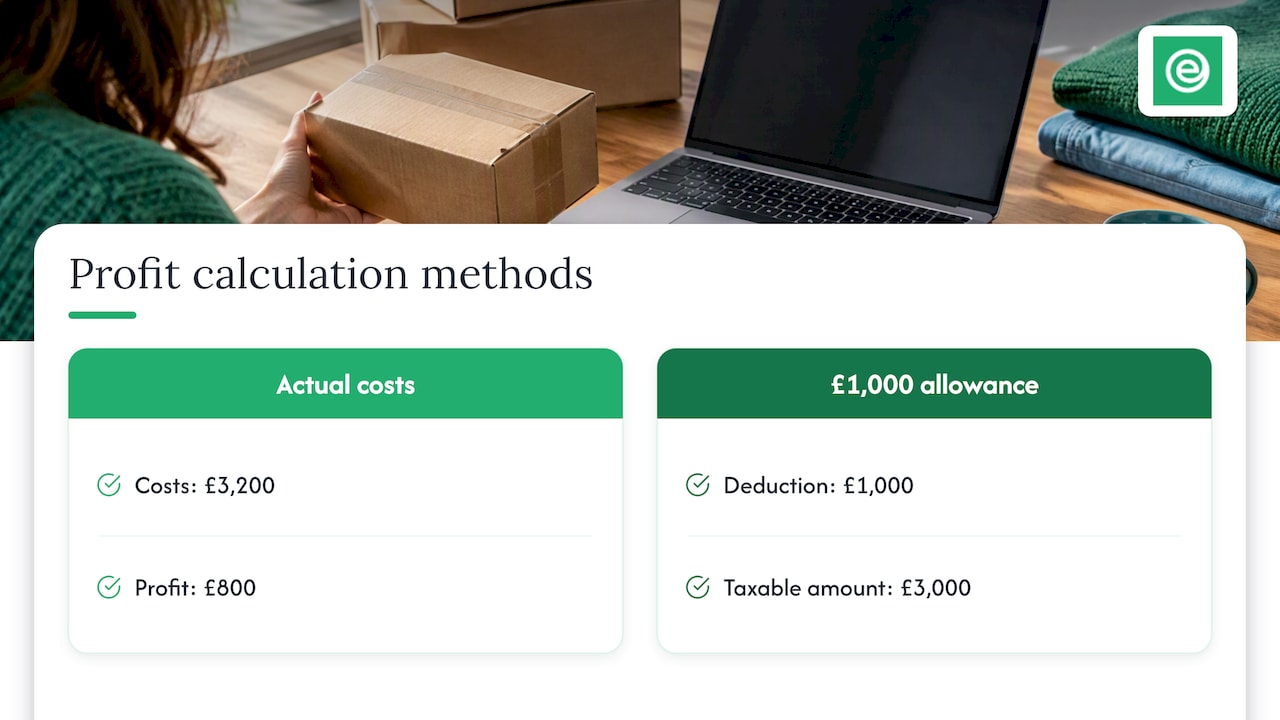
Say in a tax year you sell £4,000 of goods on eBay. The stock cost £2,300, postage and packaging cost £400, and fees were £500. Your profit is £4,000 minus £3,200, which is £800. Because your gross income is over £1,000, you must register and report it. Claiming actual costs gives £800 profit. Claiming the £1,000 allowance instead would leave £3,000 taxable, so you would not choose it. Whether tax is then due depends on your other income that year. A small profit on top of a salary is taxed at your normal rate. A small profit on its own may fall within your personal allowance.
If expenses exceed income, a loss can sometimes be carried forward against future trading profit. That is a reason to report even when you made nothing.
What about Capital Gains Tax?
Most eBay selling is income tax territory, not capital gains. Capital Gains Tax can matter when you sell a valuable item you own personally at a gain. HMRC’s manual covers what counts as a disposal cost for a chattel, such as packing and carriage when selling. Collectors selling rare items should look at the specific rules. Our guide to Pokémon cards and tax shows how that plays out for one popular category.
VAT is a different test
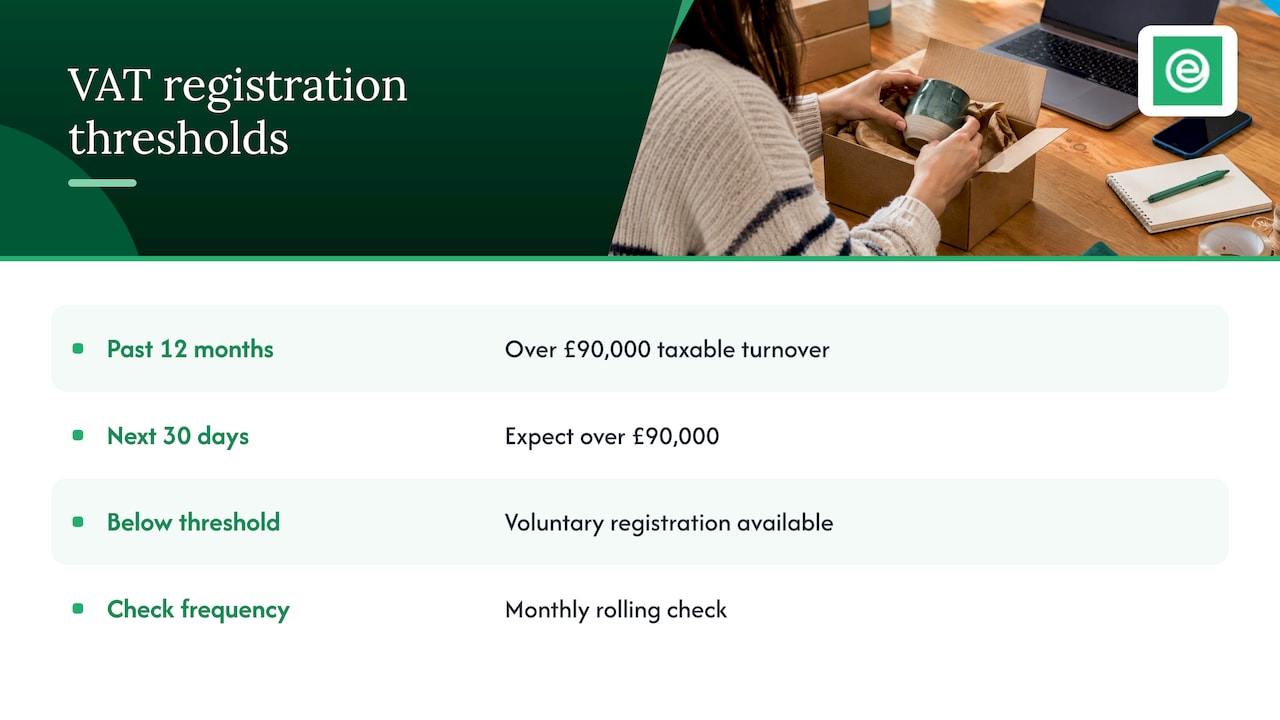
People often mix up the £1,000 allowance and VAT. They are unrelated. You must register for VAT if your taxable turnover over the last 12 months exceeds £90,000, or you expect it to exceed £90,000 within the next 30 days. Voluntary registration is available below that level.
Turnover here is your total taxable sales across everything you trade, not only eBay. A seller doing £60,000 on eBay and £35,000 on their own website has passed the line. The check is rolling, so do it monthly, not once a year. Our guides cover the £90,000 rolling threshold and the 30 day rule and what happens if you go over.
Once registered, you charge VAT on taxable sales, reclaim it on business purchases and file returns. The rules differ if you sell from stock held in the UK versus importing goods or selling to the EU. If that is you, read our overview of VAT for Amazon, Shopify and eBay sellers.
Making Tax Digital for sole traders
If your qualifying income is high enough, you will also need digital records and quarterly updates. HMRC’s schedule has the Income Tax threshold at £50,000 from April 2026, falling to £30,000 from April 2027 and £20,000 from April 2028. Plenty of growing eBay sellers will cross those lines sooner than they expect. See our practical guide to MTD for Income Tax.
What to do, step by step
- Decide your status. Clear-out seller or trader? Write the reasoning down.
- Start records now. Export eBay transaction reports, keep supplier invoices and note postage costs.
- Total all trading income for the tax year, across every platform.
- Register for Self Assessment if you are over £1,000. Do this early; HMRC has an improved registration service, and you may also want to register to pay voluntary Class 2 National Insurance.
- Choose allowance or actual costs when you file.
- Watch VAT turnover monthly against £90,000.
Our perspective
Most sellers who come to us are not avoiding tax. They are afraid of a letter they do not understand. The pattern we see is the same: eBay reports data, the seller assumes a bill is coming, and nobody has checked whether they are trading at all. Once the status question is answered and the records are in order, the problem usually shrinks.
Our view is that good bookkeeping from day one is cheaper than rebuilding a year of sales later. Every client is paired with a dedicated accountant, and we work in Xero with tools like Link My Books so marketplace sales, fees and payouts are reconciled as you go. For an eBay seller, that means the figure on your tax return matches what eBay sent HMRC.
— Kris Corbisiero, Founder at eAccounts
How we can help
If you are trading on eBay and want the records, return and VAT handled, our all-inclusive ecommerce plan starts from £29 + VAT a month. We are a Xero Platinum Partner based in Swansea, and our team looks after UK online sellers every day. You can also see how we work with eBay sellers, or start with bookkeeping on its own.
FAQ
Do I pay tax on eBay sales if I only sell my own unwanted things?
No. Selling personal items you own and no longer need is not trading, so no tax is due however much you make. Keep a note of what you sold in case HMRC asks, because eBay may still report your account.
Does eBay take tax from my sales?
No. eBay charges its own fees, but it does not deduct Income Tax for you. It reports your details to HMRC when you reach its threshold, and you declare any taxable profit yourself through Self Assessment.
How much can I sell on eBay before I pay tax?
For personal items there is no limit. For trading, you can have £1,000 of gross income in a tax year without telling HMRC. Over that, you register and declare, and tax is due only on profit above your allowances.
Do I need to register for VAT as an eBay seller?
Only when taxable turnover passes £90,000 in a rolling 12 months, or you expect to pass it in the next 30 days. You can also register voluntarily below that. The £1,000 allowance has no bearing on VAT.
What if I sell on eBay and Vinted?
Your trading income across both counts towards the one £1,000 allowance. Add the totals together for the tax year and register for Self Assessment if the combined figure is over £1,000. Our guide to when HMRC finds out about your Vinted, eBay and Etsy sales explains how each platform reports to HMRC.
Sources
- Information for online sellers, GOV.UK
- Tax rules for selling online, HMRC guide
- Check if you need to tell HMRC about your income from online platforms, GOV.UK
- Tax-free allowances on property and trading income, GOV.UK
- Tax rules for side hustles explained, HMRC guide
- Short Tax Return notes 2026, HMRC
- UK digital sales reporting, eBay
- CG15260 Capital Gains Manual, GOV.UK
- Register for VAT, GOV.UK
- Making Tax Digital for Income Tax for sole traders and landlords, GOV.UK
- Improved Self Assessment registration service, GOV.UK