If you are a sole trader, you pay Class 4 National Insurance at 6% on profits between £12,570 and £50,270, and 2% on anything above that, for the 2026/27 tax year. It is worked out on your taxable profit, not your sales, and you pay it through Self Assessment. If you sell on several marketplaces, our All-inclusive plan covers the bookkeeping and VAT side from £29 + VAT a month. This guide shows the sums, the dates and the traps.
Key takeaways
- Class 4 is 6% on profits from £12,570 to £50,270 and 2% above £50,270 in 2026/27, according to GOV.UK.
- It is calculated on taxable profit, so every allowable expense you record lowers it.
- It is paid with your income tax: by 31 January after the tax year, plus payments on account on 31 January and 31 July.
- Class 4 does not build State Pension entitlement. Class 2 is the class that can, and it is now optional for lower profits.
- If you also have a job, Class 1 paid through PAYE can affect your total, so check before you assume the sum.
Table of Contents
- What Class 4 National Insurance is
- 2026/27 rates and thresholds
- Worked examples
- What happened to Class 2?
- When you pay Class 4
- Payments on account: the real January surprise
- Lowering the base: expenses and accounting method
- If you are employed and self-employed
- Our view
- How we can help
- FAQ
- Sources
What Class 4 National Insurance is
Sole traders pay income tax and National Insurance on business profits, and Self Assessment calculates both. Class 4 is the profit-related National Insurance charge. There is no separate form and no separate payment: the amount appears on your tax return and is added to your income tax bill.
The starting point is the taxable profit of your trade, which means allowable business expenses come off first. Sales of £60,000 with £25,000 of allowable costs gives a profit of £35,000, and Class 4 is worked out on that figure.
The legal basis is that Class 4 contributions are payable in the same manner as income tax, under assessments made through the tax system. That is why it follows your Self Assessment dates.
2026/27 rates and thresholds
| Slice of annual profit | Class 4 rate |
|---|---|
| Up to £12,570 | Nil |
| £12,570 to £50,270 | 6% |
| Over £50,270 | 2% |
The £12,570 figure is the Lower Profits Limit and £50,270 is the Upper Profits Limit, both confirmed on the GOV.UK self-employed National Insurance rates page. The annual rates are set in law each year by regulations, and the 2026 re-rating regulations cover Class 4 among others.
Note the word “slice”. The 6% applies only to the profit between the two limits, not to your whole profit. Crossing £12,570 by £1 does not cost you 6% of everything.
Worked examples
These are our own calculations from the rates above. They cover Class 4 only, not income tax.
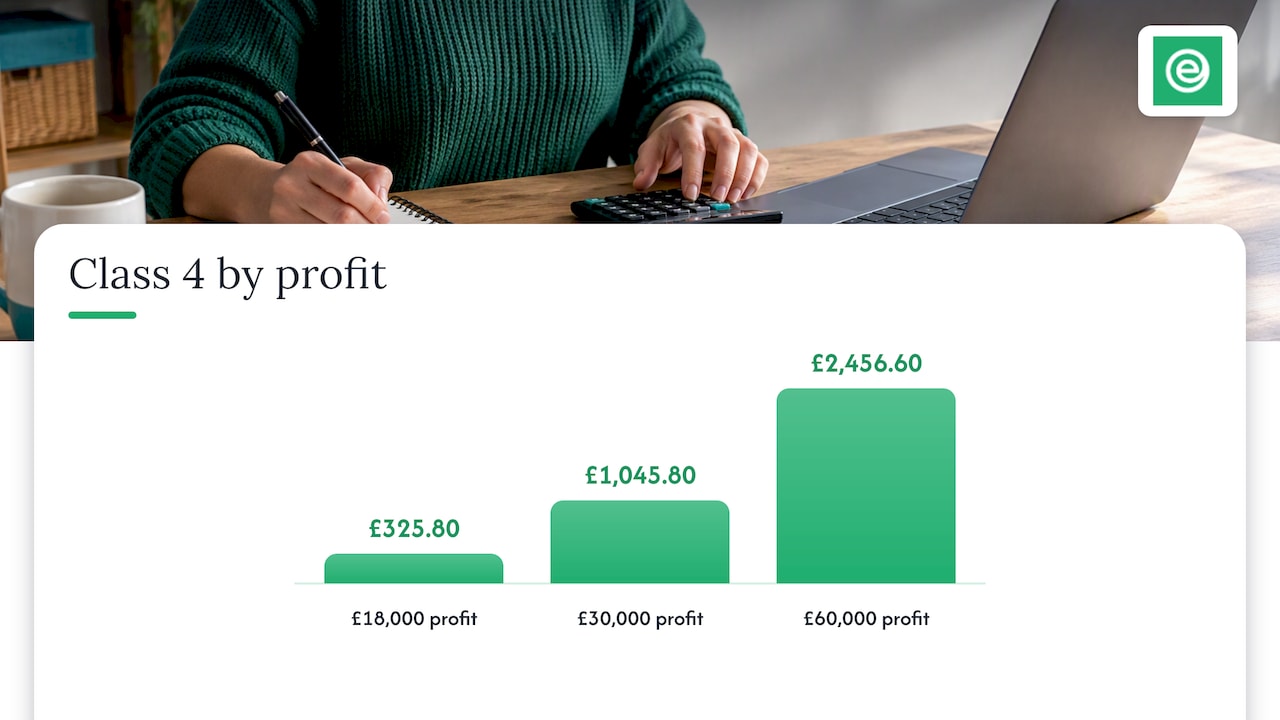
Profit of £18,000
£18,000 minus £12,570 is £5,430. At 6% that is £325.80.
Profit of £30,000
£30,000 minus £12,570 is £17,430. At 6% that is £1,045.80.
Profit of £60,000
- £50,270 minus £12,570 is £37,700. At 6% that is £2,262.00.
- £60,000 minus £50,270 is £9,730. At 2% that is £194.60.
- Total Class 4: £2,456.60.
If your profit is £12,570 or less, you owe no Class 4 at all.
What happened to Class 2?
Class 2 used to be a flat weekly charge for every sole trader above a small threshold. The government removed the requirement to pay it for those with profits above the small profits threshold, to simplify the system while keeping the link to contributory benefits.
For 2026/27, one tracker reports that profits of £7,105 or more normally earn a qualifying year for the State Pension without paying Class 2. Below that, you can pay voluntarily at £3.65 a week. If your profits are small, that is worth considering. Check your record on your personal tax account, or speak to HMRC or an accountant before deciding, because the right answer depends on your existing contribution years.
Class 4 itself does not count towards benefits. It is a tax-like charge on profit, which is why it does not help your State Pension record.
When you pay Class 4
Class 4 travels with Self Assessment, so the dates are the same:
- 5 October: register for Self Assessment if you started trading in the previous tax year and have not yet registered.
- 31 January: file your return online and pay any balance, including Class 4, for the tax year that ended the previous April. For a business that started trading between 6 April 2025 and 5 April 2026, the first return is due by 31 January 2027.
- 31 July: second payment on account, where one applies.
If you have not registered yet, our guide to registering for Self Assessment with HMRC walks through it. For return-specific detail see our Self Assessment guide.
Payments on account: the real January surprise
Most new sole traders are caught out here, not by the Class 4 rate. Once your first bill is settled, HMRC normally asks for advance payments towards the next year. These are two instalments, on 31 January and 31 July, and they include Class 4 as well as income tax.
A simple illustration with made-up round numbers: if your first year produces a combined tax and Class 4 bill of £4,000, your January bill is £4,000 plus a first advance payment of about £2,000. A second £2,000 follows in July. Your first January can therefore cost around one and a half times the bill itself.
The practical fix is a habit, not a trick:
- Move a fixed share of every payment you receive into a separate savings account.
- Update the figure each month from your real profit, not a guess.
- Put 31 January and 31 July in the calendar the day you register.
If profits fall, you can ask HMRC to reduce payments on account. Do it with evidence, since underpaying can bring interest.
Lowering the base: expenses and accounting method
Class 4 rides on profit, so legitimate costs matter. Allowable expenses are those wholly and exclusively for the business. For an online seller that typically means stock, platform fees, postage, packaging, software and advertising, though your own circumstances decide what qualifies.
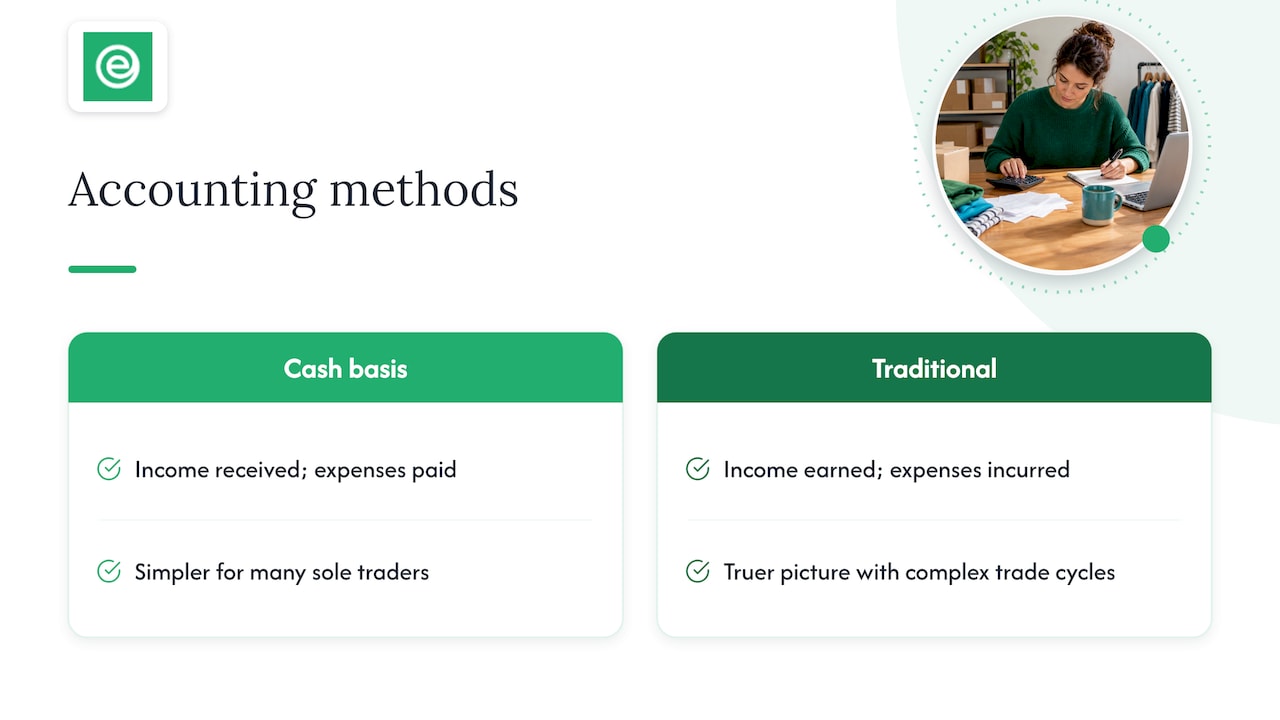
How you record income matters too. You can use cash basis or traditional accounting: cash basis records income when you receive it and expenses when you pay them, while traditional accounting records them when they are earned or incurred. Cash basis is simpler for many sole traders, but if you hold significant stock or have complex trade cycles, traditional accounting can give a truer picture. Switching has rules, so ask before you change.
Good records are the cheapest way to find every expense. HMRC expects you to keep them, and our piece on sole trader bookkeeping covers retention and Making Tax Digital dates. Making Tax Digital for Income Tax is also changing how often you report, so read our practical MTD guide if your income is near the qualifying level.
If you are employed and self-employed
Many people run a side business while on a payroll. Class 1 is deducted from your wages, Class 4 is charged on the self-employed profit, and the two can interact. HMRC sets an annual maximum for people who pay both, designed to stop overpayment in some cases.
The common mistake is to add two separate calculations and assume that is the total. Do not do that blindly. If your wages are high and your profit is modest, or the reverse, get the figures checked, because the maximum may reduce what you owe or allow a refund claim.
Our view
We look after sole traders and small limited companies across the UK, and the same pattern repeats. Nobody is upset by 6%. People are upset by being surprised: a January bill they had not saved for, a return filed late because receipts were in a shoebox, or an expense they never claimed.
Our advice is to treat Class 4 as a running cost you accrue monthly, like rent. Keep your books current in cloud software, check your profit each month, and set tax money aside from day one. That is how having a dedicated accountant helps in practice: someone who knows your numbers can tell you in October what January will look like, not in February.
Online sellers have an extra wrinkle. Marketplace fees, refunds and stock timing all move profit, so reconcile properly. Profit is what drives Class 4, and bad reconciliation distorts it in both directions.
— Kris
How we can help
Our accounting packages for sole traders and small businesses start from £29 + VAT a month, with a dedicated accountant, cloud bookkeeping and help with your Self Assessment. See the accounting packages or, if you want us to prepare your return, our personal tax return service.
FAQ
How much Class 4 National Insurance will I pay?
For 2026/27 you pay 6% on profits between £12,570 and £50,270 and 2% above £50,270. On a £30,000 profit that comes to £1,045.80. Nothing is due if your profit is £12,570 or less.
Do I pay Class 4 if I am also employed?
Yes, on your self-employed profits. Class 1 is taken from your wages separately, and an annual maximum can apply when you pay both, so check the combined figure with an accountant or HMRC.
Does Class 4 count towards my State Pension?
No. Class 4 does not build entitlement. Profits of £7,105 or more normally give a qualifying year without Class 2, and below that you can pay Class 2 voluntarily at £3.65 a week if you want to protect your record.
When is Class 4 due?
It is paid through Self Assessment, with the balance due by 31 January after the tax year ends. Payments on account fall on 31 January and 31 July.
Sources
- Self-employed National Insurance rates, GOV.UK
- Understanding business taxes, Business.gov.uk
- NIM24605, HMRC National Insurance Manual
- DMBM525930, payment of Class 4 NICs, HMRC manual
- 2026 National Insurance re-rating regulations, legislation.gov.uk
- Spring Budget 2024 personal tax factsheet, GOV.UK
- What National Insurance do self-employed people pay in 2026/27, ByteStart
- HS222 How to calculate your taxable profits (2026), GOV.UK
- Business records if you’re self-employed, GOV.UK
- NIM24189, annual Class 4 maximum, HMRC manual