
Chase on the first day an invoice is overdue, in writing, with the invoice attached. Then escalate in fixed steps: a firm follow-up, a phone call, a final notice that mentions your right to statutory interest, a Letter Before Action and, only if needed, a court claim. That sequence is what we walk our UK ecommerce accountants clients through when a wholesale buyer, marketplace partner or business customer goes quiet. This guide gives you the timings, the legal rights, the wording and the bookkeeping that goes with each stage.
Key takeaways
- Start chasing the day after the due date. Waiting is the most common mistake, and a consistent routine tells customers that late payment is not acceptable.
- Between businesses, you can claim statutory interest at 8% above the Bank of England base rate, plus fixed compensation of £40, £70 or £100 per late invoice.
- A Letter Before Action must give at least 14 days before you start court proceedings. Money Claim Online covers fixed sums up to £100,000 in England and Wales.
- Prevention does most of the work: clear terms, accurate invoices, purchase order numbers and an easy way to pay.
- Keep your books current in your accounting software. You cannot chase what you cannot see.
Table of Contents
- When is a payment actually late?
- Stop late payment before it starts
- The escalation ladder, step by step
- Interest and compensation: what you can claim
- Non-legal levers that work
- Letter Before Action and going to court
- Where to get outside help
- Our perspective: chasing is a bookkeeping job first
- Keep your books ready for the chase
- A short checklist for your next overdue invoice
- FAQ
- Sources
When is a payment actually late?
Before you send a stern email, check the date you are chasing against. GOV.UK explains that if no payment date is agreed, a debt becomes late 30 days after the customer receives the invoice, or after the goods or service are delivered, whichever is later. If you do agree a date, it must usually be within 60 days when the customer is a business.
This matters because your rights to interest and compensation only start once the debt is legally late. It also matters for tone. If your invoice says “due on receipt” but your contract says 30 days, the customer will point at the contract. Make sure the due date on the invoice matches the terms you agreed.
These rules cover business-to-business sales. They do not apply to consumers, so if you sell to the public through a marketplace, the marketplace pays you on its own payout schedule and your chasing is a different job.
Stop late payment before it starts
The cheapest chase is the one you never send. Research from the Department for Business and Trade found that administrative errors such as missing purchase orders or failed invoice logging were cited by 24% of businesses as a main driver of late payment. Many delays are your customer’s paperwork problem, and you can design most of them out.
Before the first invoice goes out:
- Put terms in writing. State the payment period, the late payment interest rate you will apply and any stop-work or credit-hold right. Agree them before work begins.
- Get the purchase order number. If the customer’s accounts team needs one, adopt a simple rule: no purchase order, no invoice, and no invoice, no payment.
- Invoice promptly and accurately. Include your contact details, a clear description of what you are charging for, the amount, the due date and your bank details. The FSB’s guide to debt recovery starts with exactly this: invoice as normal, and check that every invoice contains what a payer needs.
- Make it easy to pay. A payment link, bank transfer details in the footer or a Direct Debit for repeat customers removes friction.
- Find the right person. Ask who approves invoices and when the payment run happens. A named contact in accounts payable is worth more than a generic inbox.
The escalation ladder, step by step
Most guides agree on the shape: friendly first, firmer later, formal last. The timings below are a sensible default, not a legal requirement, except where we say so. Adjust them to your contract and the size of the debt.
| Stage | Timing | Action | Tone |
|---|---|---|---|
| 0 | 3 to 7 days before due | Courtesy reminder (optional for large or new accounts) | Helpful |
| 1 | Day after due date | Email reminder with invoice attached | Friendly |
| 2 | Around 7 days overdue | Second email plus a phone call | Polite but firm |
| 3 | Around 14 days overdue | Final notice mentioning interest and compensation | Firm |
| 4 | Around 21 to 30 days overdue | Letter Before Action, 14 days to pay | Formal |
| 5 | After the LBA deadline | Money Claim Online | Legal |
Stage 1: the friendly reminder
Send it the day after the due date. Assume an honest mistake, because it usually is. Practitioners recommend attaching the invoice to every reminder, which removes the “I never received it” and “I can’t find it” excuses in one move.
Every reminder should carry the invoice reference, the exact amount, the original due date and a clear request, as this set of UK templates also lists. For example:
Subject: Invoice INV-1042 (£1,850.00), due 3 November
Hi Sam, our records show invoice INV-1042 for £1,850.00 was due on 3 November and hasn’t yet reached us. I’ve attached another copy. Could you let me know when payment will be made? If it’s already on its way, thank you, and please ignore this note.
No adjectives, no guilt. Just facts and a question.
Stage 2: follow up and pick up the phone
If there is no reply within a week, email again and ring. A call finds out in two minutes what ten emails will not: whether the invoice is stuck in approval, disputed, or simply forgotten. Ask three things: has the invoice been received, is there any problem with it, and on what date will it be paid? Then confirm the answer by email the same day, so you hold a written promise.
If they commit to a date and miss it, say so politely and move on to the next stage. A broken promise is a reason to escalate, not to wait again.
Stage 3: the final notice
This is where you state your legal position for the first time. Keep it calm and specific: the invoice is now overdue by a stated number of days, you are entitled to statutory interest and fixed compensation, and you will send a Letter Before Action if payment is not received by a named date.
Seasoned practitioners report that simply mentioning the right to statutory interest and compensation in the final notice is often enough to secure payment without an interest invoice ever being sent. You do not have to charge it. You do have to be willing to.
Interest and compensation: what you can claim
Under the late payment rules, statutory interest on business debts is 8% above the Bank of England base rate, unless your contract sets a different rate. Check the current base rate and the rate that applies to your debt on GOV.UK before you quote a figure, because it moves.
On top of interest, you can claim fixed compensation. GOV.UK’s guidance on debt recovery costs sets these sums:
| Size of the debt | Fixed compensation |
|---|---|
| Under £1,000 | £40 |
| £1,000 to £9,999.99 | £70 |
| £10,000 or more | £100 |
If those sums do not cover your reasonable recovery costs, you can claim the difference.
Should you actually charge it?
That is a judgement call. Some freelancers find that merely stating the intention to charge interest is enough, while others save it for clients who have proved persistently unprofessional or unresponsive. Our view: apply it automatically to repeat offenders and to large debts, and use it as a bargaining chip with a good customer who had one bad month. Either way, say so in your terms from day one so it never comes as a surprise.
Non-legal levers that work
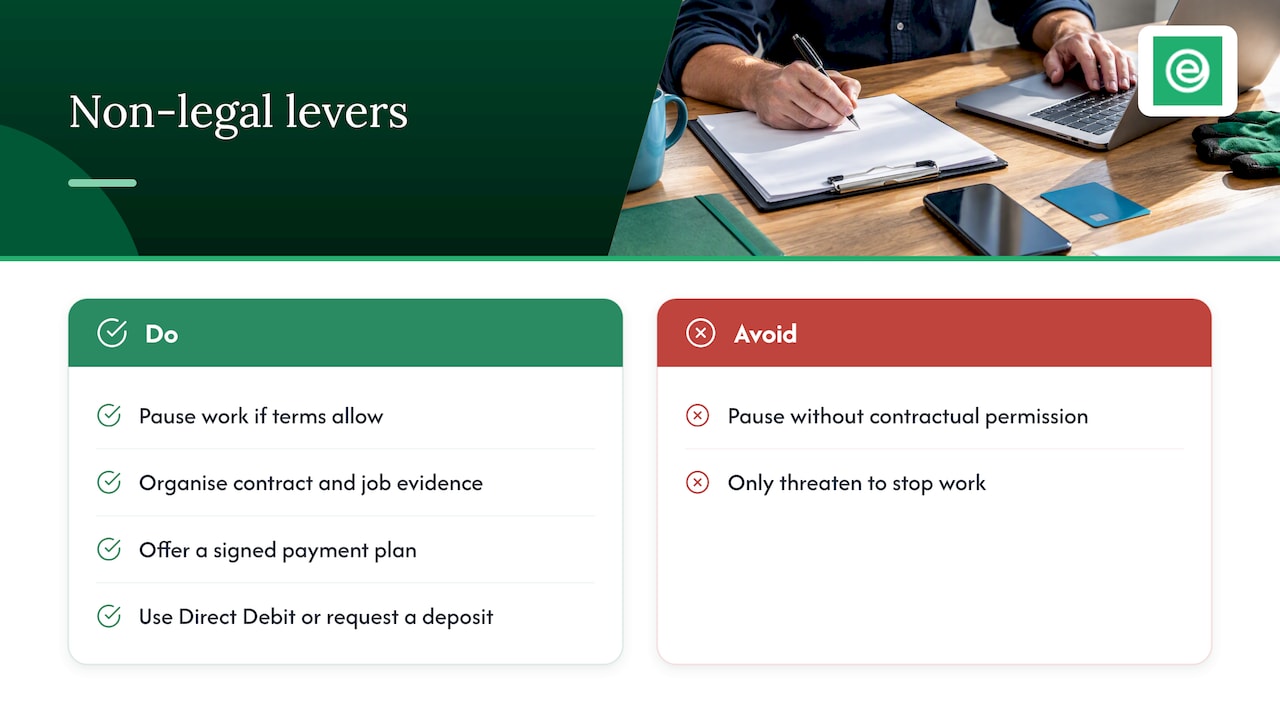
Before going near a court, consider a pause. Business owners and tradespeople often use a credit hold or stop-work notice. The FSB’s debt recovery guidance explains the practical point: if your contract allows it, actually pausing work, not just threatening to, is often the quickest way to start a real conversation about payment.
Two cautions. First, only do this if your written terms permit it, otherwise you may be in breach yourself. Second, keep your paperwork organised: the contract, the quote, proof of delivery or completion, and every message. That evidence turns a he-said-she-said argument into a straightforward breach-of-contract case.
Other options that cost nothing: offer a short payment plan for a customer in genuine difficulty (a signed schedule is far better than silence), switch repeat customers to Direct Debit, or ask for a deposit on the next job.
Letter Before Action and going to court
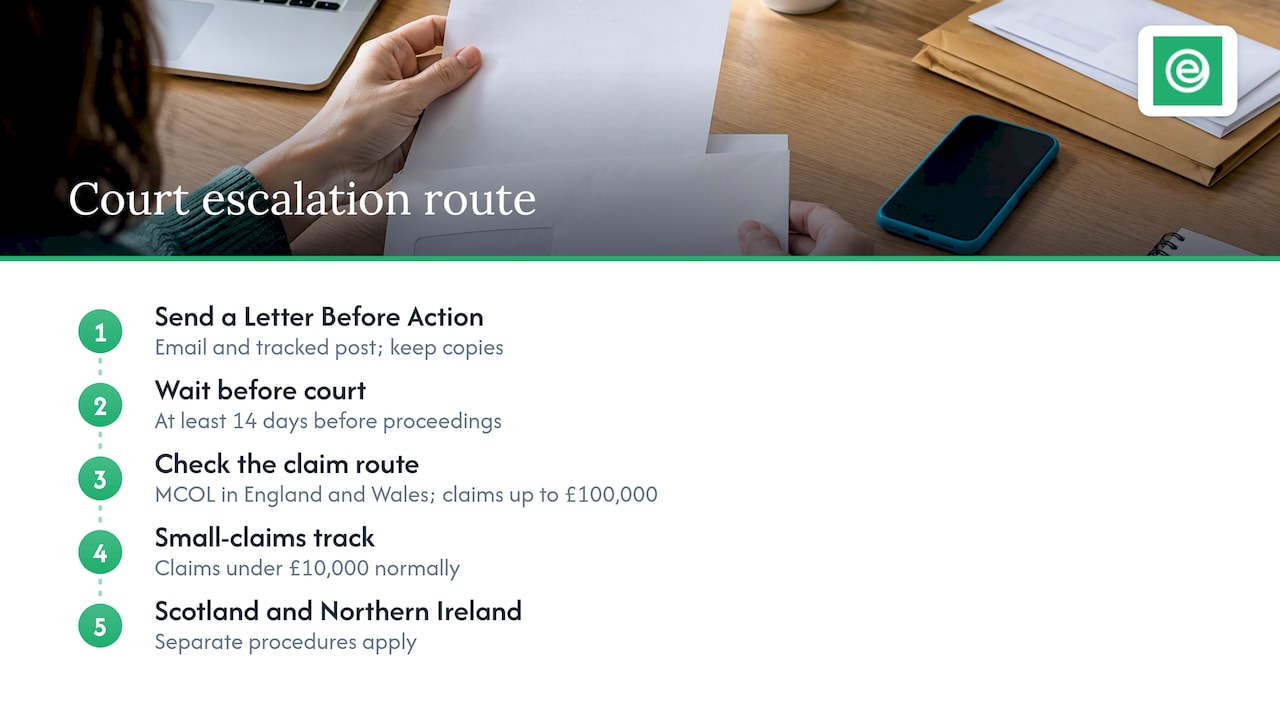
If the final notice date passes, send a formal Letter Before Action. It should set out the debt, how it arose, the interest and compensation you are claiming, and a deadline. GOV.UK says it should be sent at least 14 days before you start court proceedings. Send it by email and by tracked post, and keep copies.
This letter is frequently the real trigger. It signals that you are prepared to pursue a County Court Judgment, and many debtors pay at this point.
If they do not, Money Claim Online is the government service for businesses in England and Wales to claim fixed amounts of up to £100,000. Claims under £10,000 normally go through the small claims track. Scotland and Northern Ireland have their own procedures, so check the rules for where the debtor is based. The HM Courts & Tribunals Service guide EX350 on debt recovery through the County Court gives one piece of advice worth repeating: find out as much as possible about your customer before you take them to court. A judgment is only worth having against someone who can pay it.
Where to get outside help
If your customer is a large business that pays everyone late, you may not be alone. The government is strengthening support for small suppliers, with proposals that include a 30-day limit on raising disputes, so that “spurious disputes” cannot reset the payment clock. It also plans to widen the Small Business Commissioner’s powers to investigate poor payment practices and impose financial penalties on large businesses. The Small Business Commissioner has announced it will be able to settle late payment disputes out of court. Check the current position before relying on any proposed power, since these measures are still moving through the process.
Our perspective: chasing is a bookkeeping job first
When clients tell us a customer will not pay, the first thing we look at is not the customer. It is the books. Is the invoice recorded correctly? Does the bank feed show a part-payment that was never matched? Was the VAT right? A surprising number of “late payers” turn out to have paid something, or to be disputing a figure that was genuinely wrong.
So we build chasing into the monthly routine. With every client paired with a dedicated accountant, overdue invoices are reviewed alongside reconciliation in Xero, not discovered at year end. For online sellers, we also see the cash flow side: a £1,850 invoice that is 45 days late can mean you delay paying your own supplier or VAT bill. That is why we pair debtor chasing with a forward-looking cash flow forecast, so you know which late payment actually hurts.
Our advice is simple. Be polite, be consistent and be early. Treat the legal tools as a backstop that you mention calmly, not a weapon you wave. Most customers respond well to a supplier who is clearly organised.
— Kris Corbisiero, Founder at eAccounts
Keep your books ready for the chase
A chase is only as strong as your records. You need an accurate list of who owes what, by when, which is exactly what accounts receivable ageing in your accounting software gives you. Review it weekly. If you update your books irregularly, our guide on how often you should update your books explains why monthly is the minimum.
If you would rather not do this yourself, our bookkeeping services keep your sales ledger reconciled so you always know the exact figure to chase. Our plans start from £29 + VAT a month, and you can see what is included on our accounting packages page.
A short checklist for your next overdue invoice
- Confirm the due date matches your agreed terms.
- Check the invoice is correct and was received by the right person.
- Send a friendly reminder with the invoice attached on day one.
- Phone within a week and confirm the promised date in writing.
- Send a final notice stating interest and compensation if still unpaid.
- Send a Letter Before Action with at least 14 days to pay.
- Start a Money Claim Online claim only after checking the customer can pay.
- Record every step in your books, including any interest or compensation you receive.
FAQ
How do I chase an overdue payment politely?
Assume a genuine mistake and keep the first message short: invoice number, amount, due date and a clear question about payment timing. Attach the invoice every time. Following up by phone within a week is usually more effective and more courteous than sending a long run of emails.
Can I charge interest on a late invoice?
Yes, if the customer is another business. GOV.UK sets statutory interest at 8% above the Bank of England base rate unless your contract says otherwise. You can also claim fixed compensation of £40, £70 or £100 depending on the size of the debt.
How long should I wait before taking legal action?
There is no fixed waiting period, but you must send a Letter Before Action at least 14 days before starting court proceedings. Most businesses reach that stage after several unanswered reminders and a final notice, often a few weeks after the due date.
Is there a way to dispute a late payment?
If the customer genuinely disputes the invoice, ask them to say what is wrong in writing and respond to it. If they will not engage, you can still escalate with a Letter Before Action and, if needed, a claim through Money Claim Online. A clear contract and proof of delivery make a dispute much easier to resolve.
Sources
- GOV.UK: Late commercial payments, interest and debt recovery
- GOV.UK: Claim debt recovery costs
- GOV.UK: Make a court claim for money
- GOV.UK: Commercial Payments Bill overview
- Department for Business and Trade: late payments research
- Small Business Commissioner: new powers
- FSB: What is the process for debt recovery?
- HMCTS: EX350 guide to debt recovery through the County Court
- Freelancing for Journalists: do we need to get tough about late payment?
- 1nvoic3: the UK escalation ladder for late-paying clients
- PennyFetch: overdue invoice email templates