
Prime Day can lift your turnover in a few days, but the cash behind those sales lands weeks later, and the VAT on them is yours from the moment of supply. If you sell on Amazon, plan three things before the event: where the money to fund stock and ads comes from, how much of each payout is really HMRC’s, and what records your accountant will need afterwards. Our Amazon Accountants team works with UK sellers on exactly this, and the rest of this guide walks through it step by step.
Key takeaways
- Prime Day sales are not cash. Amazon holds proceeds until seven days after delivery, then pays on its normal cycle, so you fund stock and advertising first.
- If you are VAT registered, 20% VAT is built into your promotional price. Treat roughly one sixth of VAT-inclusive sales as owed to HMRC, not as working capital.
- Revenue and output VAT follow the tax point (usually dispatch or delivery), not the day Amazon pays you.
- Margin matters more than rank. Fees, deal costs and inflated ad bids can turn a headline sales spike into a loss.
- Keep digital VAT records in compatible software and reconcile settlements monthly, so the quarter-end return is a check, not a rescue.
Table of Contents
- Why Prime Day strains cash flow even when sales are strong
- When Amazon actually pays you
- The VAT trap: money in your account that is not yours
- Tax point: which period do Prime Day sales belong to?
- The costs to model before you discount
- Funding the gap
- Set aside for tax, VAT and the quiet weeks
- Records HMRC expects you to keep
- Our perspective
- How we can help
- FAQ
- Sources
Why Prime Day strains cash flow even when sales are strong
A normal month has a rhythm: you buy stock, sell it, get paid, repay suppliers. Prime Day compresses the selling into a short window while the buying and spending happen well before it. That mismatch is the whole problem.
Three things pile up at once:
- Stock bought in advance. Deposits and balance payments to suppliers fall due weeks before the event, and FBA inbound shipments have to be booked in early enough to be received.
- Costs that start immediately. Advertising is charged as it runs, and Amazon’s referral and fulfilment fees come out of each sale. Amazon also applies peak fulfilment fees in the UK for certain FBA orders, typically from mid-October to mid-January, so autumn events overlap with the more expensive season.
- Money that arrives late. Amazon’s own seller guidance for the event, the Prime Day seller preparation guide, points out that higher turnover can push a quarter’s VAT liability well above a normal trading period. The sales feel like profit; the VAT bill says otherwise.
The result is a seller who looks very successful in Seller Central and is overdrawn at the bank. It is common, and it is almost always a planning problem rather than a trading one.
When Amazon actually pays you
Amazon’s reserve policy decides your gap. Under the delivery date plus seven days (DD+7) approach, funds from an order are held until seven days after delivery is confirmed, then released in the next available disbursement. Amazon announced the update to DD+7 reserve settings for 12 March 2026 in its seller forums. The policy is not new for UK sellers either: in 2023 the BBC reported that Amazon had extended it to UK sellers registered before 2016, which left some feeling squeezed.
What that means in practice:
- An order placed on day one of the event is dispatched, delivered a day or more later, then held for seven days.
- It then waits for the next disbursement run, which is not daily.
- Your Prime Day orders can therefore reach the bank two to four weeks after the sale, depending on delivery speed and where the cycle falls.
Check your own Payments dashboard before the event, because reserve settings and disbursement frequency can differ by account. The figure that matters is the one Seller Central shows you, not an average.
A simple cash timeline to build
Build a week-by-week table in a spreadsheet or in your accounting software’s forecast. Use these rows:
| Week | Cash out | Cash in |
|---|---|---|
| 6 to 4 weeks before | Supplier deposits, freight, FBA prep | Normal sales payouts |
| 3 to 1 weeks before | Balance payments, inbound shipping, pre-event ad budget | Normal sales payouts |
| Event week | Daily ad spend, deal fees, extra stock top-ups | Almost nothing from event sales yet |
| 1 to 2 weeks after | Ad spend tail, returns, supplier reorders | Early event payouts, depending on delivery |
| 3 to 4 weeks after | Quarter VAT payment if due, tax set-aside | Remaining event payouts |
The lowest cumulative balance in that table is the number you must cover, through savings, a trade credit arrangement with suppliers or, if you choose, borrowing. It is better to know it in September than to discover it on the second day of the sale.
The VAT trap: money in your account that is not yours
If you are VAT registered, the price a customer pays on Amazon includes VAT. Amazon’s guidance is that UK sellers apply the standard 20% rate to promotional prices, so the discounted price you set must still contain the right VAT amount. Discounting does not discount the VAT percentage; it shrinks your net revenue and your margin.
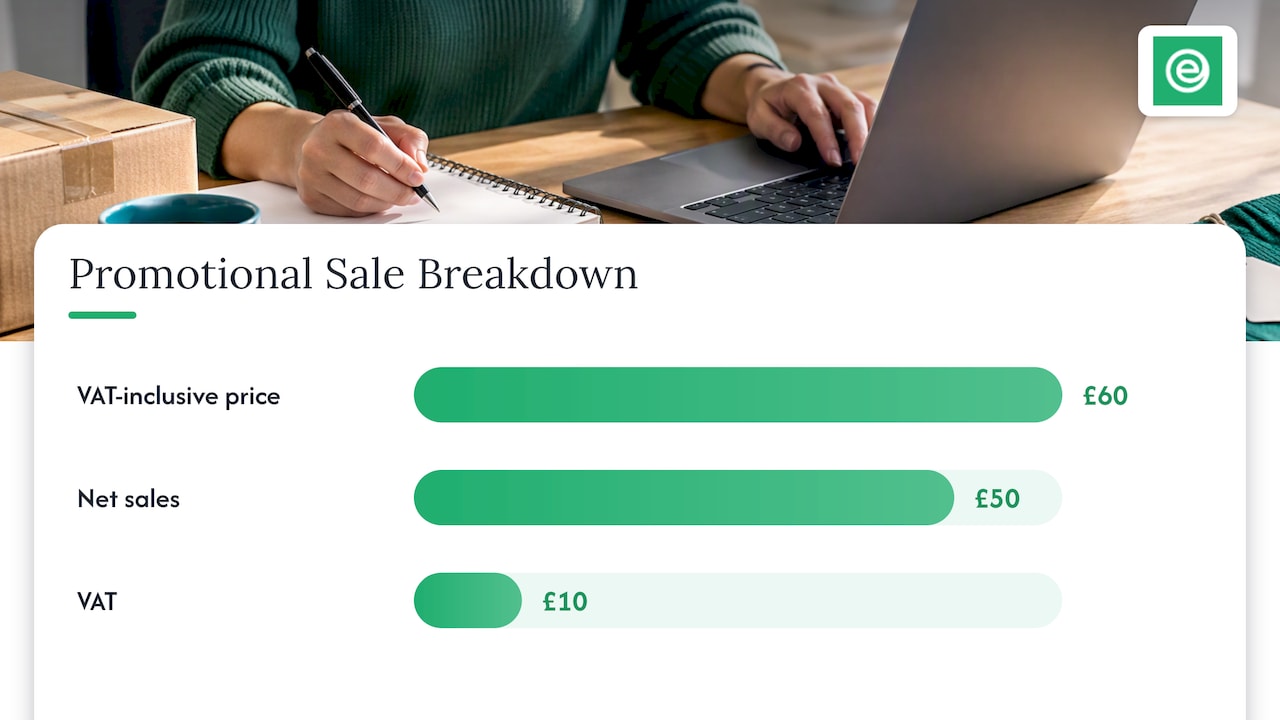
The arithmetic is simple. At a 20% rate, VAT is one sixth of a VAT-inclusive price. A £60 promotional price contains £10 of VAT and £50 of net sales. Over a Prime Day with, say, £60,000 of VAT-inclusive sales, £10,000 of VAT is accumulating, before you deduct any input VAT you can reclaim on stock, fees and advertising.
The trap is behavioural. The payout lands, the balance looks healthy, and the money is spent on stock or ads. Three months later the VAT return is due and the cash has gone.
A habit that works:
- Open a separate instant-access savings account for VAT.
- Each time a settlement pays out, move one sixth of the VAT-inclusive sales in that settlement across.
- Reduce the pot only when you actually pay HMRC or reclaim input VAT.
That is an estimate of output VAT, not your final liability. Your return will net off input VAT, and some sales will carry different treatment, for example returns or sales covered by marketplace rules. Our guide on Amazon returns and VAT explains how refunds adjust the figures.
Watch your registration position too
A big event can push you towards the registration limit. The current UK VAT registration threshold is £90,000 of taxable turnover over a rolling 12 months, and going over it has a deadline for registering. If Prime Day sales are likely to take you near that figure, read what happens if you go over the VAT threshold, and our note on the £90,000 rolling threshold and 30 day registration window. The rolling test means one huge week can trigger registration earlier than your annual figures suggest.
Tax point: which period do Prime Day sales belong to?
A common bookkeeping error is to record sales when the payout arrives. For VAT, the date that counts is the tax point, which for most goods is when they are dispatched or delivered, not when Amazon pays you. Sales made late in a VAT quarter may be paid in the next quarter, but their output VAT still belongs in the quarter of supply.
This matters in two ways:
- Your VAT return can be wrong if you build it from bank receipts rather than from sales data.
- Your profit can be wrong, because you may carry some Prime Day revenue and its costs in different periods.
The fix is to reconcile from settlement reports and sales data, not from the bank feed alone. A bank line from Amazon is a net payment made up of sales, refunds, fees, advertising and reserves. In Xero, that is normally handled by posting the settlement breakdown, whether through an integration or a manual journal, so that gross sales, fees and VAT are each in the right account.
If Amazon (or another marketplace) is the party accounting for VAT on some of your sales, the treatment changes again. Our guide to marketplace VAT and the £135 rule covers when that applies. HMRC guidance on VAT and overseas goods sold through online marketplaces sets out the rule for sellers not established in the UK. The government is also consulting on extending online marketplace liability so marketplaces account for VAT on more of the sales they facilitate for UK businesses, so check the current position when you prepare your return.
The costs to model before you discount
Prime Day is won or lost on contribution margin, not unit sales. Before you accept a deal, work out what each unit leaves after every cost attached to it.
List these per unit:
- Landed cost of the product, including freight and duty
- Amazon referral fee on the promotional price
- FBA fulfilment fee, including any peak-period surcharge
- Any fee for the deal itself
- Advertising cost per unit sold, remembering that bids and click costs often rise during the event as competitors push harder
- Expected returns and the refund cost
- Output VAT, which is not revenue
Set a floor for contribution margin in advance and stop discounting when you reach it. If the maths only works at the deepest discount, the best Prime Day decision may be to skip that product.
How these costs are treated for tax
For most sellers, the following are allowable business expenses and are deducted when working out profit for income tax or corporation tax: stock sold, Amazon fees, advertising and fulfilment. Two points catch people out:
- Unsold stock is not a cost yet. Stock you bought for Prime Day and still hold at year end is carried as closing stock, not expensed. Heavy pre-event buying can therefore make a profit look higher than your cash suggests.
- Input VAT recovery depends on invoices. To reclaim VAT on Amazon fees and supplier invoices, you need the proper VAT invoices and a record of them. Amazon fee invoices are available in Seller Central, so download them regularly.
This is why sellers can face a tax bill on a profit they cannot spend. If your accounting year ends soon after Prime Day or the Christmas peak, ask your accountant to project the tax position early.
Funding the gap
If your timeline shows a shortfall, you have options. Reinvesting a good previous quarter is cheapest. Negotiating a staged supplier payment is next. Some sellers use revenue-based advances from independent lenders, which advance cash against Amazon sales data and are repaid as sales are processed. FundBiz describes how such products work for UK sellers. They cost money, so compare the total repayable against the margin on the stock they would fund, and do not borrow against a margin you have not verified.
Set aside for tax, VAT and the quiet weeks
One practical rule of thumb from marketplace specialists is to reserve 30 to 40% of Q4 revenue for tax, VAT and post-peak costs. Treat it as a starting point rather than a rule. Your own percentage depends on your margin, VAT status and whether you trade as a sole trader or a limited company. The better method is to calculate it from your real figures:
- Set aside the VAT (one sixth of VAT-inclusive sales, less estimated input VAT).
- Estimate profit after all costs, then set aside an appropriate share for income tax and National Insurance, or corporation tax.
- Keep a buffer for January and February, when sales usually dip while storage fees, returns and supplier bills continue.
For limited companies, our piece on corporation tax rates and allowance changes explains which rate applies to your profit level.
After the event: clear slow stock early
Prime Day often leaves surplus inventory. Slow stock ties up cash and attracts storage fees, particularly long-term ones. Marketplace specialists suggest clearing it with a further deal or by switching to merchant fulfilment, and Vendlab’s seasonal guide covers that approach. Decide your clearance price using the same contribution margin floor, and remember that selling below cost can still be worth it if it frees cash that earns more elsewhere.

Records HMRC expects you to keep
VAT-registered businesses must keep digital records and submit returns through compatible software. HMRC’s Making Tax Digital for VAT notice says that includes records of supplies made and received, the time of supply, the value excluding VAT and the rate of VAT charged. Data moving between software products must use digital links, so a spreadsheet re-keyed by hand into your return is a compliance risk.
A Prime Day record checklist:
- Settlement reports for the event period, matched to bank receipts
- Sales data showing order date, dispatch or delivery date, net value and VAT
- Amazon fee, advertising and storage invoices
- Supplier invoices and proof of import VAT and duty where relevant
- Refunds and returns, with the dates they were processed
- Stock counts at the period end
We cover the day-to-day process in accounting tips for Amazon FBA sellers and the wider tax picture in our seller tax guide for UK marketplaces.
Our perspective
When sellers come to us after Prime Day, the problem is rarely the sales. It is that the books were not up to date when the event began, so nobody knew how much cash they would really have, or how much of it was VAT. Each client has a dedicated accountant, and the most useful conversation we have with an Amazon seller is a forecast a few weeks before the event, not a clean-up after it.
Our advice is simple. Reconcile settlements monthly, not quarterly. Move VAT out of sight when you are paid. Decide your margin floor before you see the traffic. And do not let a good week persuade you that the tax can wait. We work in Xero, as a Xero Platinum Partner based in Swansea, and connect it to tools that break Amazon settlements into sales, fees and VAT, so that your quarterly return is built from clean data.
— Kris Corbisiero, Founder at eAccounts
How we can help
If you want a cash flow forecast, VAT returns and year-end accounts handled by one accountant who knows your business, our all-inclusive ecommerce plan starts from £29 + VAT a month. It covers marketplace sellers on Amazon FBA and FBM, Shopify, Etsy and eBay, and includes ongoing support from a dedicated accountant. If you also want the software side set up properly, see our Xero online accounting service.
FAQ
How long does Amazon take to pay UK sellers after Prime Day?
Under the DD+7 policy, funds are held until seven days after delivery and then released in the next disbursement. Depending on delivery time and your payment cycle, that can mean waiting around two to four weeks for the money. Check your Payments dashboard for your own schedule.
Do I charge VAT on Prime Day discounted prices?
If you are VAT registered, yes. Amazon’s guidance says the standard 20% rate applies to promotional prices. The discounted price must include the correct VAT, so your net revenue per unit falls with the discount.
Which VAT period do Prime Day sales fall into?
They fall into the period of the tax point, which is usually dispatch or delivery, not the date Amazon pays you. An order sold late in one quarter and paid in the next still belongs in the earlier VAT return. Build your return from sales and settlement data rather than from bank receipts.
Could Prime Day push me over the VAT threshold?
It can. The registration threshold is £90,000 of taxable turnover over a rolling 12 months, so a very strong event can bring forward the date you need to register. Check your rolling total before and after the event, and speak to an accountant if you are close.
Sources
- Amazon Prime Day seller preparation guide
- Amazon peak season fees and dates, seller forum
- Amazon DD+7 reserve update, seller forum
- BBC News: Amazon sellers and withheld cash
- GOV.UK: VAT and overseas goods sold using online marketplaces
- GOV.UK: Extending online marketplace liability factsheet
- GOV.UK: VAT Notice 700/22, Making Tax Digital for VAT
- FundBiz: Amazon seller funding UK
- Vendlab: Amazon seasonal selling strategy